
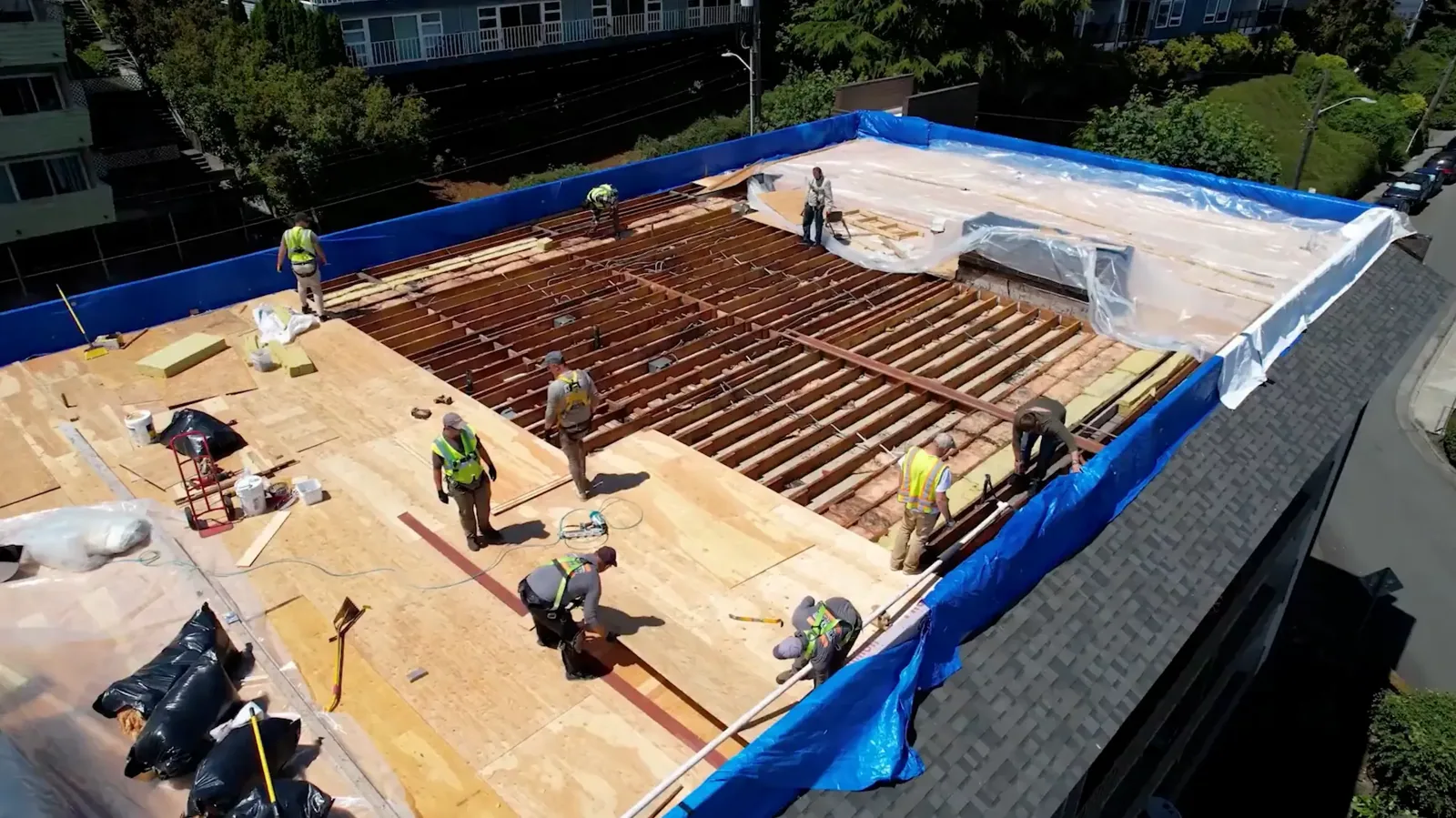
Fire Damage Roof Repair in Denton, TX
A fire report does not define the roof repair boundary. In Denton, TX, separate visible heat effects, smoke residue, water from suppression, and any opening made for response. Record the affected roof area, inspection date, access limits, and the owner contact who can coordinate with fire officials. Keep each observation tied to the fire-area reference that supports it.
Heat may affect membrane, insulation, adhesives, coatings, metal, and nearby penetrations in different ways. Smoke deposits can also obscure the surface. Do not assume that discoloration equals a failed assembly or that material outside the visible area is unaffected. Our commercial roof inspection documents accessible conditions and identifies what needs controlled testing or replacement.
Confirm the Release and Access Plan
Before a roof visit, confirm that the authority controlling the scene has released the area and that the owner has approved access. Coordinate with the fire investigator, facility staff, insurer representative, and other trades as assigned. Identify unstable components, hot surfaces, debris, and any area that remains restricted. The access record should state who authorized entry and which locations could not be reached.
Suppression water or a temporary opening can change the condition after the fire. Photograph the roof before debris removal when that is permitted. Label later observations by date so an owner can distinguish fire effects from response work or subsequent weather. A roof condition report can organize the map, images, access limits, and open questions into one reviewable record.
Inside the building, protect occupants, equipment, and inventory under the owner's direction. Coordinate temporary weather protection with the approved safety plan. Emergency response is available overnight, through weekends, and on holidays, but access still follows property authorization and scene controls.
Separate Heat, Smoke, and Water Findings
Map blistering, shrinkage, loss of adhesion, softened material, exposed reinforcement, warped metal, and any open seam only where observed. Record the distance from the apparent origin without treating it as a uniform heat boundary. Smoke residue may require a separate cleaning or environmental decision. Suppression water can enter at a damaged opening or travel from another roof detail.
Record the assembly from closeout documents, labels, or an appropriate field review. A roof may contain several phases or different materials around additions. Keep each system identified. Where an opening is already present, test only after authorization and document the sample location and restoration method. An infrared moisture survey may support test-point selection when the assembly and conditions make readings useful.
Trace interior staining to the roof map but do not assign the entry point from the ceiling alone. A wind-related roof assessment belongs as a separate scope if wind displacement is also observed. Keep pre-existing heat-related surface wear separate from fire findings. A heat and UV degradation review addresses a different exposure question. The fire repair boundary should retain only conditions supported by the record.
Decide What Can Remain
Material appearance is not a substitute for assembly evaluation. Compare the affected surface with an undamaged area, review records, and identify whether the membrane, insulation, deck, or attachment needs confirmation. A limited test opening can answer a specific question when approved and restored correctly. State the method, limits, and who will interpret the result.
A localized repair may fit where heat or impact is bounded and adjoining material remains compatible with a new tie-in. Replacement may be needed where the roof assembly is unstable, materially damaged, or cannot be restored under the applicable system method. Keep salvage, removal, cleaning, temporary enclosure, and permanent reroofing as different lines so the owner can review each decision.
Cost and timing depend on scene access, debris handling, material testing, roof assembly, occupied operations, and coordination with other trades. Do not finalize concealed quantities before approved investigation. The replacement scope should identify its boundaries and temporary weather controls separately from a limited patch.
Plan Around the Denton Property
In the 1991 to 2020 Denton climate normals, annual precipitation totals 38.44 inches and midsummer mean maximum air temperatures approach 96°F. These values can frame weather planning after a fire; they cannot show whether insulation or membrane saw heat. Use the scene record and direct roof observations to set the scope.
The City identifies Downtown TIRZ as a defined area established to provide infrastructure intended to encourage downtown redevelopment. That district information is city context, not a statement about any individual building or fire event. For a property near downtown, the owner should identify the loading area, roof contact, tenant schedule, and any restricted access before a repair sequence is priced.
Bonnie Brae Street is the subject of a City improvement project spanning an approximately three-mile stretch between Scripture Street and Loop 288. Confirm today's work-zone and entry conditions before mobilizing. The road record informs the trip plan only; fire effects must be established from the released roof area and assembly.
Stage Stabilization Before Permanent Work
If weather exposure remains, define a temporary enclosure or cover with the site contact and safety team. State its attachment method, inspection interval, removal plan, and responsibility for monitoring. Photograph the temporary condition separately from permanent repairs. A short-term measure should not be presented as final restoration.
Permanent work may need to wait for investigator access, material test results, drying, or replacement components. If the building is occupied, set controls for odor, noise, ventilation, debris, and work zones. A project near the Krum service area still requires property-specific access and governing permit confirmation; the municipality name alone does not determine the route or approval.
When water entry continues, protect the affected interior and record the area. A emergency repair response can address immediate exposure while the permanent scope is developed. Keep the temporary action, permanent repair, and any replacement alternate in separate sections of the proposal.
Keep the Event Record Traceable
Retain the owner-reported event date, official scene release, inspection date, roof plan, photographs, test records, repair scope, invoices, and completed-work images. Identify which items describe fire effects and which relate to suppression, debris removal, or later exposure. Preserve scope versions and exclusions so a reviewer can see what changed.
Our claim documentation support can organize the observed conditions and repair records for review. It does not determine policy coverage or fire causation. Those decisions depend on the actual policy, investigation, and evidence accepted by the parties handling the claim.
After work, photograph the completed transitions and any adjoining area left unchanged. Record unresolved questions and the next inspection date. This gives a future property manager a usable starting point instead of an undocumented assumption about what the fire affected. Store access approvals with the same file. Keep test-opening locations clear enough for a later reviewer to compare the restoration with the original investigation boundary.
Commercial Roofing Questions
Can the roof be inspected before the fire investigation is complete?
Only within access approved by the authority and property owner. We record released areas and exclusions, then schedule any restricted locations after authorization.
Does smoke discoloration mean the membrane must be replaced?
Discoloration alone does not set the repair boundary. Identify the system, surface condition, heat exposure, and any testing needed before comparing cleaning, repair, and replacement.
How should suppression water be handled in the scope?
Map water reports and roof entry points separately from heat findings. State temporary protection and moisture confirmation as distinct work items.
When can permanent roof repairs begin?
The scene release, owner authorization, safe access, drying, testing, and material availability can affect the start. Put each prerequisite and schedule assumption in the scope.
What records help with an insurance review?
Keep event and inspection dates, the roof map, original and completed photographs, test results, temporary measures, invoices, exclusions, and scope versions together.