
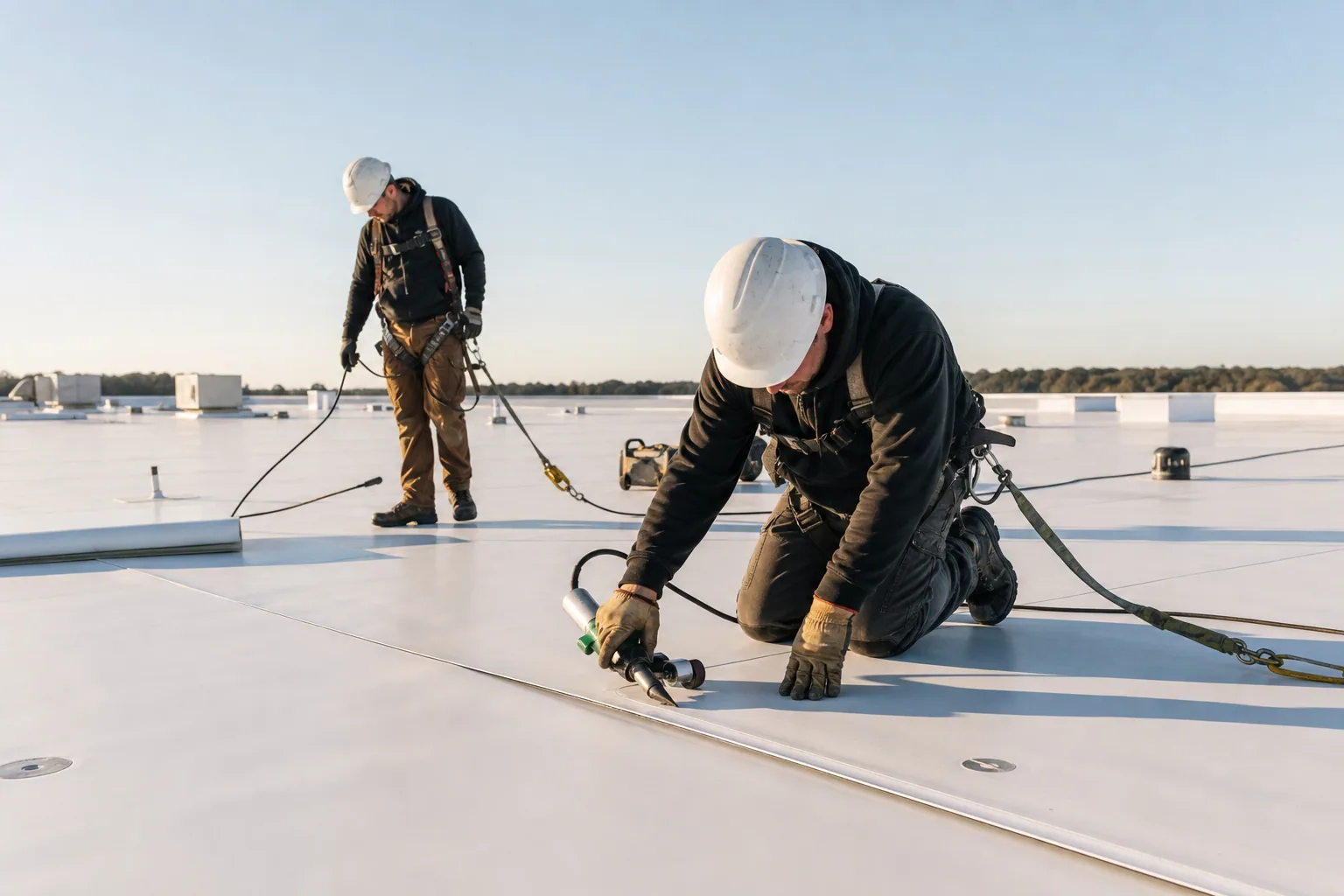
Commercial Roof Coating in Denton, TX
A coating belongs on a roof that can support it. In Denton, TX, a sound substrate, compatible surface, dry insulation, and repairable details come before color or coverage. We inspect the existing assembly, map open seams and flashings, and test areas that raise a moisture question. Then we state whether restoration is a candidate or whether removal and replacement deserve comparison. The owner receives an observed-condition record, not an assumption based on appearance. Begin with a roof inspection that identifies the roof area and its current repair history.
Confirm the Roof Can Receive a Coating
First identify the existing membrane or surface, its age if documented, previous coating layers, and repairs that may affect adhesion. A coating does not correct wet insulation, weak attachment, open deck, or unresolved movement. We inspect blisters, splits, seam edges, penetrations, drainage, and areas where water remains. If test cuts or adhesion tests are needed, mark their locations and record results separately. The scope should say which surface preparation is included and how failed areas will be handled.
Westpark’s industrial area lies north of Airport Road. Its regional land use does not establish the material or condition of a particular roof. A coating evaluation there still depends on the specific building. A project near Bonnie Brae Street also needs current access and delivery planning because work timing can change. Those location details affect staging, while the assembly findings determine whether a restoration system can be applied.
Prepare the Surface Before Application
Preparation is not a cosmetic step. Remove loose coating, dirt, biological growth, and unsound material as the selected system requires. Repair seams, fasteners, flashing transitions, and penetrations before covering them. Confirm the surface is clean and dry enough for the product instructions. A test patch can expose adhesion or compatibility concerns before the crew commits to a larger area. We document preparation limits and identify any roof zone excluded from the coating scope.
At a standing seam or metal roof, movement and fastener conditions need review before coating. At a membrane roof, the field surface and welded or adhered seams may need different treatment. A targeted repair can remain the better choice where defects are isolated. Where water entry tracks to a failed seam, a seam repair review helps define the correction before restoration is considered.
Resolve Water Before Covering
Standing water changes the coating discussion. Map low areas, drains, scuppers, overflow routes, and any ponding after a dry interval. A coating follows the existing slope unless the scope adds a designed correction. It should not be sold as a substitute for drainage work. If the roof needs slope or drain changes, show those lines separately and explain how the proposed coating detail connects to them. A drainage scope may be required first.
Denton averages 38.44 inches of annual precipitation in the 1991 to 2020 normals. That is regional context for planning, not evidence that a particular roof ponds or leaks. The inspection should record actual flow paths and drain condition. Nearby Downtown TIRZ and Westpark identify different kinds of city districts, yet neither label proves the condition of a building inside it. The roof plan and observed water behavior decide the sequence.
Match the System to the Existing Assembly
Coating selection depends on substrate, existing materials, exposure, and detail design. Silicone and acrylic systems have different application and maintenance characteristics; neither is a universal fix. We compare product requirements with the roof condition and owner objective. The proposal identifies primer, reinforcement, application limits, wet-film or dry-film criteria when specified, and treatment at penetrations and edges. If the substrate cannot be confirmed, the scope says what test would reduce that uncertainty.
Heat is another planning input. Denton's climate record puts July's mean maximum at 95.9°F and August's at 95.8°F. Those air readings do not measure a roof surface. We schedule by actual conditions and manufacturer instructions, including temperature, moisture, and cure window. The record should preserve the selected coating system, preparation, and closeout measurements so future maintenance can distinguish the restored area from adjacent roofing.
Compare Restoration With Replacement
Restoration can avoid a full tear-off when the existing assembly is dry, stable, attached, and suitable for the selected system. Replacement may be more appropriate where moisture is widespread, layers are unstable, deck conditions are uncertain, or the roof's details cannot be reliably restored. A recover may also be considered if the assembly meets project requirements. We compare these paths using the same roof areas and stated assumptions, rather than placing a coating price beside an undefined replacement number.
For a phased building, break out areas that can be restored from sections requiring removal. Record tie-ins, access, temporary protection, and the effect of work near occupied operations. The owner may compare a coating line with a replacement scope and a capital timing review. Loop 288 and US 380 serve as local access corridors, but current road work and site entry require confirmation before delivery dates are fixed.
Warranty terms also belong in the comparison. Review who issues the coverage, which materials and areas it includes, required maintenance, exclusions, and the notice process for a suspected defect. Do not treat a coating proposal as a warranty extension unless the document expressly states that result. We list the supplied terms with the scope version, so the owner can separate product requirements from contractor work and future maintenance obligations.
Preserve the Restoration Record
Closeout should record surface preparation, test results, repairs, application areas, material batches, and any conditions left outside the scope. Keep photographs tied to roof zones. If a coating has a manufacturer's maintenance requirement, include the supplied instructions in the owner's file; do not substitute a generic inspection interval. A future visit should identify cracking, loss of adhesion, punctures, open transitions, and debris before those observations become a new repair scope.
For access from Argyle or Lewisville, confirm the project address, authority, and delivery route with the site contact. These municipalities are distinct from Denton, and permitting or access may differ. We use the actual property record to set the coating boundary, document the work, and identify the next decision date. The result is a traceable restoration scope with clear limits and a practical maintenance handoff.
Commercial Roofing Questions
When is coating a poor fit for a roof?
Widespread wet insulation, unstable layers, poor attachment, unresolved movement, or a failing substrate can make coating unsuitable. We map those findings and identify what testing remains before comparing restoration with replacement.
Will a coating correct ponding?
Not by itself. The existing slope and drainage remain unless the project includes a designed correction. We map low areas and drain conditions, then separate any drainage change from the coating line so the owner can see what each item accomplishes.
How do you confirm adhesion?
The selected system and substrate determine the test method. A test patch can reveal compatibility concerns, but it does not replace inspection of seams, details, or wet areas. We record its location, preparation, and result before a broader application is authorized.
Can coating go over an older coating?
Only after the existing layer is identified and found suitable for preparation and adhesion. Loose or incompatible material must be addressed. We state the test area, removal limits, and any condition that would stop the application.
What should be compared against replacement?
Compare the same roof areas, preparation, repairs, access, exclusions, and treatment of concealed conditions. We show the coating assumptions beside a replacement scope, then identify the condition that would change the selected path.