
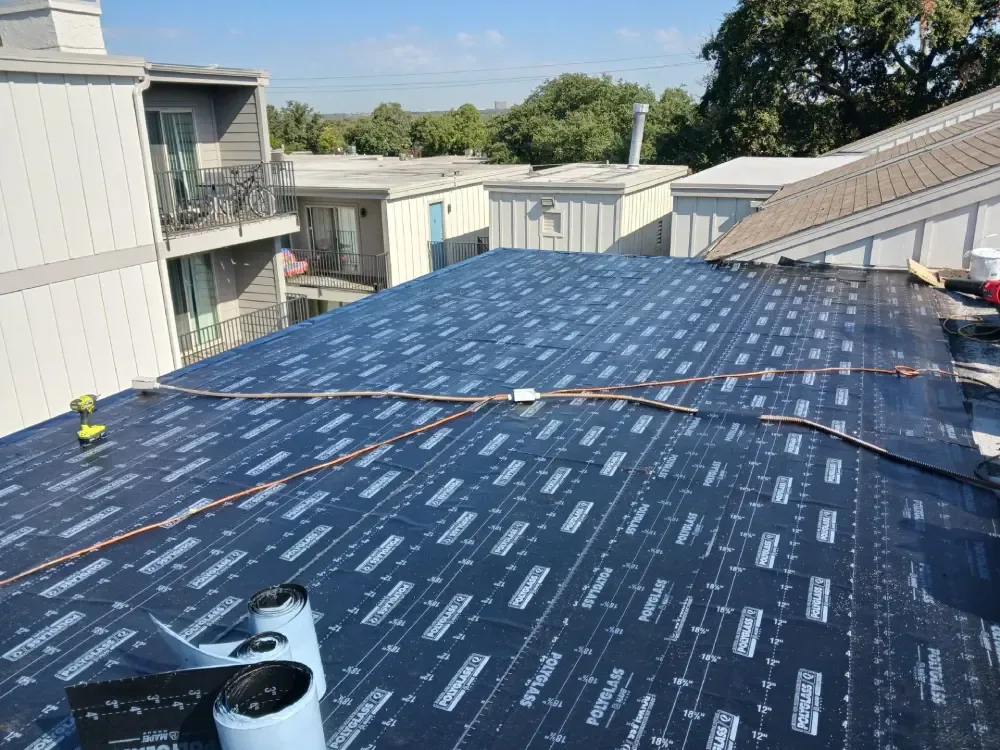
Modified Bitumen Roofing in Denton, TX
A blister near a roof edge changes the inspection plan. It does not by itself establish that the modified bitumen assembly has failed. Record the roof area, surface condition, nearby laps, drainage, and prior repair history before setting the scope. In Denton, TX, tie each photo to a location and inspection date.
Modified bitumen uses asphalt modified with polymers in one or more plies. The exact assembly may include a base sheet, cap sheet, surfacing, insulation, and different attachment methods. Confirm those details from records or an approved test opening. A commercial roof inspection can distinguish visible conditions from layers that remain concealed.
Map the Existing Layers
Start with available submittals, closeout records, repair invoices, and warranty documents. Identify whether the assembly is torch-applied, adhered, mechanically attached, or built in another configuration. Record where those details are known. Roof sections completed at different times may not share the same materials or attachment.
Look for exposed edges, patches, changes in surfacing, and transitions that reveal a prior recover. A test cut may be needed to confirm the number of plies or the condition below the cap sheet. Set a clear location, protect the building, and restore the opening under the agreed method. Do not infer the full assembly from one small sample.
Modified bitumen can be compared with other low-slope systems, but the roof and owner requirements control the choice. The built-up roofing review and TPO system overview can frame system differences for a bid discussion. They do not replace a property-specific assembly record.
Separate Surface Wear from a Leak Path
Inspect the cap sheet for open laps, splits, exposed reinforcement, displaced surfacing, punctures, and earlier patches. Mark each condition on the roof map. A surface defect may admit water, but an interior stain can also reflect water traveling from a nearby transition or drain. Record both observations without joining them into a cause until the evidence supports it.
Blisters, wrinkles, and ridges should be described by location, size, and relationship to seams. Do not cut or press a feature without an approved method. If moisture is suspected below the surface, record what further testing would answer the question. An infrared moisture survey may help select confirmation points when conditions and assembly make the readings useful.
A repair scope should identify the preparation, compatible materials, tie-in, protection, and closeout photos. State the repair boundary and any concealed condition that remains unresolved.
Check Flashings and Hot-Work Controls
Review base flashing at walls, curbs, drains, pipes, parapets, and roof edges. Look for open terminations, cracked mastic, loose metal, damaged surfacing, or movement where a vertical surface meets the field. Photograph the full transition and the close detail. Identify which trade controls equipment, utilities, and protection during the work.
Some modified bitumen installation methods use heat. Where torch work is proposed, confirm the project method, fire watch, combustible conditions, occupied operations, and permit requirements with the responsible parties. Do not assume that an existing roof or nearby tenant area is suitable for hot work. A a roof safety review can record access and fall-protection issues, while the scope should assign fire prevention and monitoring responsibilities.
Where hot work is not appropriate, compare an approved cold-applied or self-adhered detail if the exact system permits it. Document the selected product and the preparation needed for the existing surface.
Trace Drainage and Seasonal Access
Map drains, scuppers, overflows, low areas, and locations where surfacing or debris restricts flow. Check whether water stands near a seam or flashing. Record the observed condition and date. Ponding alone does not identify a leak path or prove that the entire assembly needs replacement.
Denton's NWS climate normals show warm summer conditions and annual precipitation. Those regional averages can inform planning questions, but they do not measure the roof surface or demonstrate damage at a specific property. Use the actual assembly, weather during the visit, and owner access rules to set inspection limits.
The City maintains a Bonnie Brae Street project page for improvements along an approximately three-mile segment from Scripture Street to Loop 288. Current construction timing and property access need confirmation before a site visit. That street project is scheduling context, not evidence about a roof condition.
For maintenance items, a preventive roof maintenance plan can list debris removal, drain checks, photo updates, and follow-up dates separately from capital repairs.
Compare a Repair Line with Capital Work
A repair may fit when the affected area is bounded, adjacent plies are stable, and compatible materials can make a sound tie-in. Broader work deserves review when multiple areas show similar distress, patches repeat, or test openings reveal wet or degraded layers. Identify the evidence behind each option and any assumption that could change it.
Before comparing recover with tear-off, document the roof stack, deck, fastener condition, edge geometry, drain elevations, and permit questions for the governing authority. The City identifies Downtown TIRZ as a defined area for infrastructure investment intended to encourage downtown redevelopment. That district context does not establish a building's roof age or owner decision.
A replacement scope should identify removal boundaries, occupant protection, sequencing, temporary water control, debris handling, and project records. Keep the repair alternate separate. Use the same roof area, access assumptions, and exclusions across bids so the owner can compare cost and timing directly.
Set the Denton Access Plan
Confirm the roof access contact, tenant hours, staging area, delivery path, and decision date before pricing mobilization. Denton's access plan should account for the two routes highlighted in city development materials: Loop 288 and US 380. Check posted work zones and drive conditions for the inspection date; a map reference cannot set the arrival window.
Krum is a nearby city, but municipal boundaries do not define service availability. Confirm the property location and authority governing the work. Keep travel, access, and inspection assumptions visible in the proposal instead of embedding them in a repair unit price.
For an occupied facility, identify noise, odor, fire-watch, and temporary protection requirements. If access or weather prevents a complete review, list the excluded areas and the follow-up needed to close the record.
A warranty file review can organize product, inspection, and repair documents for the owner. It does not establish coverage for a condition without review of the actual warranty terms.
Keep the Repair Record Traceable
Retain the roof map, dated photographs, assembly records, scope version, access record, test-opening restoration, product documents, and unresolved items in one closeout file. Label each image with its roof area and view direction. A reviewer should be able to distinguish the original observation from the completed work.
After installation, photograph prepared surfaces, completed laps, terminations, and transitions before they are covered or access changes. Record any field adjustment and the reason for it. If a leak returns, compare the report with the prior repair line and check whether the new location matches an earlier observation.
Use the same record standard for an isolated patch and a larger project. The owner should be able to see what was inspected, what was repaired, which questions remain, and when the next decision is due.
Commercial Roofing Questions
How can an owner tell how many plies are present?
Review project records and inspect exposed edges. If layers remain uncertain, an approved test opening can confirm a limited area; document its location and restoration.
Does a blister mean the modified bitumen roof needs replacement?
No. Record its size, location, and relation to seams or moisture findings. The repair or replacement decision depends on the assembly and broader roof condition.
When should torch work be considered?
Confirm the exact installation method, fire-watch plan, combustibles, occupied operations, and permit requirements. If those conditions do not fit, review another approved method.
Can a cap sheet be patched over an older repair?
Only after checking the existing surface, adhesion, compatibility, and concealed condition. The scope should define preparation and the tie-in to sound material.
What belongs in a modified bitumen closeout file?
Keep the dated roof map, layer records, test-opening record, product information, installation photographs, exclusions, warranty documents, and follow-up items together.