
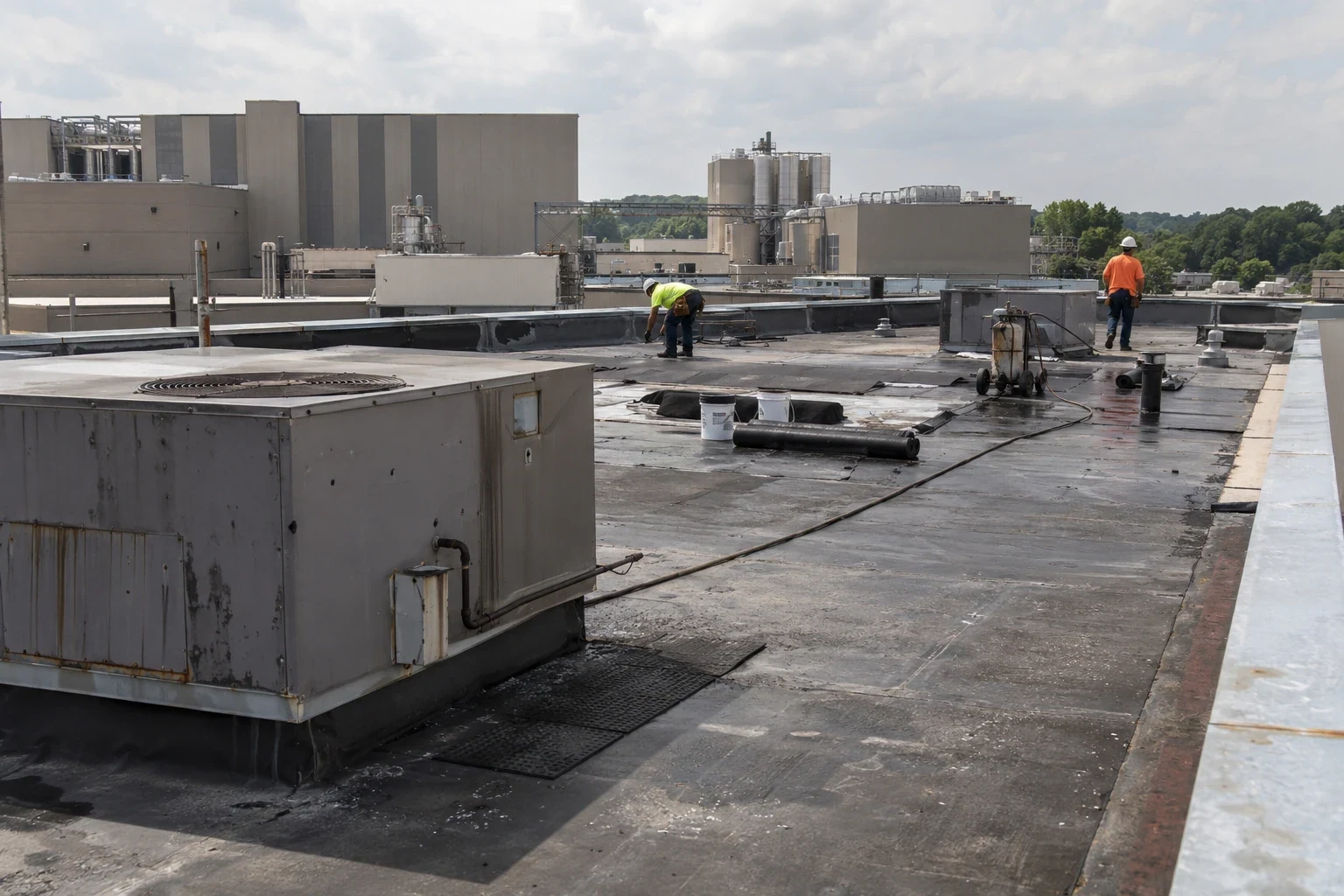
Roofing for Manufacturers in Denton, TX
A production shift does not pause because a roof report arrived. In Denton, TX, the roof scope has to account for operating zones, exhaust equipment, interior protection, and the date a maintenance window is available. We inspect the installed assembly, record the areas reached, and tie each finding to a roof zone. That gives plant leadership a specific decision: protect an active area, repair a defined defect, investigate further, or plan a capital project. Emergency response remains available around the clock when water threatens operations.
Manufacturing roofs can include membrane fields, metal panels, curbs, vents, process exhausts, and later additions. The assembly must be confirmed at the building. A manufacturing property review addresses the physical roof, while a logistics operator scope considers a different set of loading and movement constraints. Neither label replaces a field inspection.
Trace Roof Findings to Production Areas
Ask which line, room, or equipment area was affected and when the condition appeared. Keep that report separate from observations on the roof. We photograph seams, fasteners, penetrations, drains, curbs, and prior patches with a roof-zone reference. If access is blocked by process equipment or a safety rule, the report names the limit and next approval needed. A ceiling stain alone does not establish where water entered.
Inspect transitions around exhaust, piping, ductwork, and supports as distinct details. Vibration, heat, or later equipment changes can affect the surrounding flashing, but the scope should describe what is actually present. A curb and support review can identify those details, and a moisture survey may help define an investigation area where approved. Record the test method and limits before using results to price a broader repair.
Set the Work Window With Operations
Confirm production windows, roof access, hot-work rules if relevant, equipment clearance, lift staging, and the interior protection plan. Name the operations contact who can approve a pause or a changed sequence. If work is above an active line, define the drop zone, materials path, and handoff at the end of each shift. The proposal should include setup, cleanup, and any owner action that must happen before the crew arrives.
Denton planning identifies Loop 288 and US 380 as corridors relevant to access and development. A corridor description is not an entry plan for a plant. Current traffic, construction, gate instructions, and delivery limits need confirmation. Westpark TIRZ is described as an industrial district north of Airport Road, which offers city context but does not establish the use or roof type at any parcel. For site-specific timing, a phased occupied-building plan can identify work areas and operations dependencies.
Keep Repair and Capital Options Distinct
A localized repair may be suitable where a seam, penetration, fastener, or flashing defect is limited and the adjacent assembly remains serviceable. We define the repair boundary, method, exclusions, and any condition that could expand the work. If water entry recurs across separate zones or moisture findings extend beyond a single detail, further testing or a broader option may be warranted. The owner receives the evidence behind the recommendation.
Replacement, recover, or coating each carry different access, removal, tie-in, and shutdown implications. Check moisture, attachment, drainage, and system compatibility before considering a recover or coating. A TPO system review begins with the assembly found in the field. We can compare a repair scope with a replacement option using the same work areas, production assumptions, and owner responsibilities.
Apply Denton Data Carefully
NWS climate normals assign Denton July and August mean maximums of 95.9°F and 95.8°F, with 38.44 inches of annual precipitation. These are regional scheduling inputs, not readings from a factory roof. They do not measure the roof surface or establish a manufacturing building’s leak history. At the property, we record drainage, membrane or panel condition, sealant, and evidence of water entry. The forecast and product instructions should guide the work window.
Denton’s economic-development material discusses employer activity and identifies Westpark as a local planning area; separate city materials describe two state universities. None of those references identifies a plant tenant or assembly. The property record needs its own drawing set, gate procedure, and access contact. The asset file still needs the property name, drawing set, gate procedure, and access contact. If a nearby facility lies in another municipality, Krum coverage is a separate service-area discussion with its own permit authority and site instructions.
The city plan treats Loop 288 as a key access corridor; TxDOT also has a separate US 380 project area. Check current project status and the property's receiving instructions with operations before assigning a delivery. A named corridor is context, not a confirmed truck route or promise of an arrival window.
Document the Scope Before Shift Change
Provide roof plans, equipment layouts, prior repairs, work permits, known access restrictions, and the next planned shutdown or maintenance window. We can mark roof areas and identify any proposed test opening, material staging, or interior protection. Keep the scope version attached to the schedule so plant staff can tell whether a change affects only timing or also the work boundary. Any concealed-condition allowance should describe what is unknown and how it will be approved.
At closeout, retain dated photos, areas completed, materials recorded, change approvals, exclusions, and remaining questions. Name the owner of any temporary protection and its review date. A condition report can preserve the baseline; capital planning can connect recurring observations with a budget year. For a project coordinated with a builder, the construction partner scope should define who owns roof penetrations and tie-ins before another trade alters them.
Production leaders need the same clear boundary as the roofing crew. Identify which equipment can remain in service, which area needs temporary protection, and where material or debris may be staged. If vibration-sensitive equipment or process controls sit below the work, identify the protection owner and the inspection point before the shift begins. The scope should describe the handoff between trades and record any roof opening that must remain weather-tight overnight. Those records turn an operating constraint into a sequence that can be priced and reviewed.
Commercial Roofing Questions
How can roof work fit a planned production shutdown?
We need the approved roof areas, access window, equipment constraints, and person who can release the work zone. The scope should state setup, protection, sequence, and the conditions that would extend the shift. A shutdown date alone does not define safe roof access.
What should happen when a leak is reported over a production line?
Record the room, time, equipment, and any immediate protection already in place. We can respond to active water, then inspect roof zones and nearby details that are accessible. The repair report should distinguish the reported impact from confirmed roof conditions.
Can roof penetrations be added during equipment installation?
The roof assembly, curb detail, attachment, flashing, warranty requirements, and trade sequence need review before the opening is made. We can define the roof work and tie-in responsibility in writing. The plant contact should approve the location and access plan.
When does a manufacturer need moisture testing?
Testing can help when visible conditions do not show the extent of suspected wet insulation or when a broader repair is being considered. We describe the test area, method, authorization, and restoration. The result applies to the sampled locations, not automatically to the full roof.
What should the closeout file give plant leadership?
Keep the approved scope, roof-zone photos, material records, change approvals, access limits, and any remaining condition in one dated record. List who owns temporary measures and the next review. This lets operations staff compare the completed work with the shift plan.