
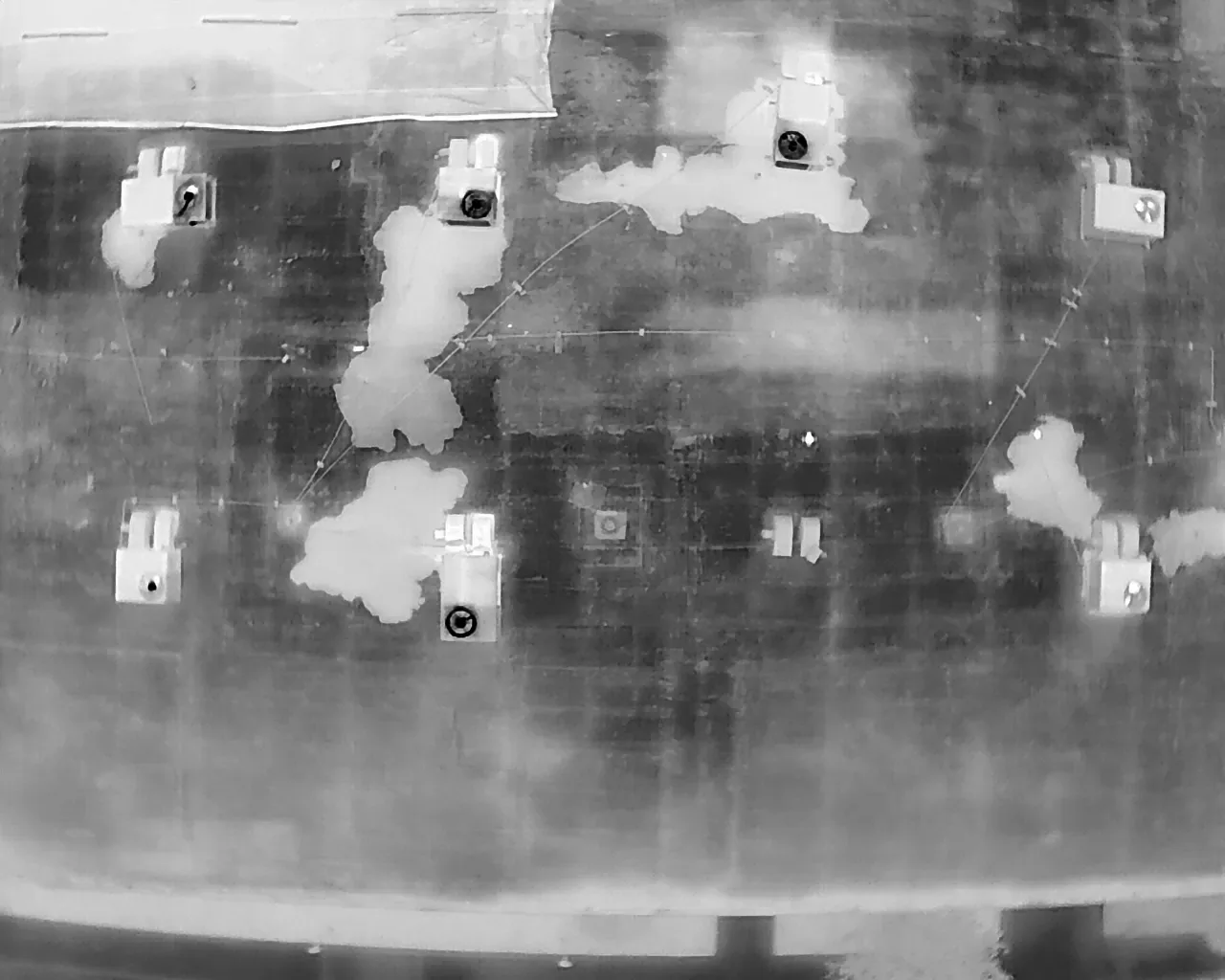
Infrared Roof Moisture Survey in Denton, TX
An infrared survey maps temperature differences that may point to moisture under a roof. It does not measure water directly. In Denton, TX, the method is useful only when surface and weather conditions support a meaningful pattern. We define the roof areas and decision first, capture the conditions, then identify locations that may need confirmation. A roof inspection helps relate the scan to visible defects and the assembly.
Set Conditions for Useful Readings
Infrared works best when the roof has experienced suitable solar loading and cooling conditions. Wind, cloud cover, surface wetness, material changes, and rooftop equipment can affect readings. The survey record records time, weather, roof surface, and any limits. A thermal pattern is a screening result, not a moisture verdict. We do not convert every color difference into a removal quantity.
Denton’s July mean maximum is 95.9°F, but a normal air reading does not establish the roof's surface temperature on survey day. The annual precipitation normal is 38.44 inches, while actual recent rainfall can differ. We check current conditions before interpreting the scan. The report ties its conclusion to measured conditions and specific roof zones.
Map the Roof Before Scanning
Divide the roof into identifiable areas and record changes in membrane, insulation, slope, or equipment. Capture a reference image and label the scan to match the roof plan. Avoid comparing unlike surfaces as if they should respond identically. A shadow, ballast, repair patch, or metal transition can create a pattern unrelated to wet insulation. Mark anomalies as candidates for further testing, with their locations and basis.
At a Westpark industrial property, for example, equipment and differing roof zones may interrupt a broad scan path. At a downtown building, access and surrounding structures may limit the available view. Those place names describe city districts, not roof conditions. The survey plan must reflect the actual site layout and permissions.
Confirm Suspect Areas
When the scan identifies a candidate area, compare it with interior reports and visible roof conditions. Test cuts may be needed to confirm moisture, insulation type, and deck condition. The owner approves locations and restoration details before openings are made. Record results by point, including dry or wet material and any limitation. If the finding is not confirmed, preserve that result rather than relabel it based on expectation.
Where water may enter at a seam or curb, an infrared anomaly alone does not locate the opening. A separate seam review or flashing assessment can examine the likely pathway. Confirmed wet insulation may require removal or a designed correction before a recover is considered.
Check What Can Distort a Scan
Different materials can store and release heat at different rates. A metal curb, ballast, repair patch, rooftop unit, wet surface, or shaded area can affect a thermal image. Record those features before assigning meaning to a color pattern. Compare like roof areas and use a visible-light image beside the thermal view. The analyst should be able to explain why each anomaly was marked for testing.
Wind and changing cloud cover may reduce contrast during a survey. If the surface has not experienced suitable conditions, readings may be inconclusive. The field team should record that limit rather than force a conclusion. A rescheduled scan or a different inspection method may answer the question better.
Keep the record tied to the roof plan. Mark roof zones, scan path, visible obstructions, and test openings. A later reviewer needs to know where an image was taken and how it was interpreted. File naming should preserve the location without exposing private tenant information beyond the authorized report.
Restore Every Test Opening
Test cuts require prior approval and a restoration detail. Confirm the location, size, access, and method before making an opening. Record the layers encountered, moisture observation, deck condition, and any limitation. Photograph the opening before and after it is restored. The closeout should identify who approved the test and whether the repair was completed before the crew left.
If a cut reveals wet material, outline the affected area and determine whether more testing is needed. Do not assume the condition stops at the first dry point. The owner can authorize additional locations after reviewing the findings. If the test is dry, keep that result tied to its exact location rather than applying it to the entire roof.
Restoration materials should suit the existing roof assembly. Confirm compatibility and secure the patch or flashing as required. The report records the completed detail and any pending follow-up. That way, a diagnostic opening does not become a new leak path or disappear from the maintenance record.
Connect the Map to the Roof Decision
The final map should separate confirmed wet areas, possible anomalies, tested-dry points, and unscanned areas. That gives the owner a basis for repair, selective removal, or a broader assembly review. State the limits of the method and the test locations. If the owner is comparing a recover with tear-off, use confirmation results to identify what can remain and what needs removal. Do not treat a percentage of colored pixels as a replacement quantity without field confirmation.
Westpark is an industrial development district, while Downtown TIRZ is an infrastructure and redevelopment area. That context can frame building use and access, but neither label establishes a roof assembly. For properties near Loop 288 and US 380, confirm current access directly with the property contact. The roof plan and findings control the recommendation.
If the owner needs a quantity for budgeting, show confirmed areas separately from untested or inaccessible sections. Identify assumptions behind any allowance and the next step that would narrow it. A scan can target that work, but an anomaly should not become a removal quantity without confirmation.
Deliver the Scan With Its Limits
The report includes the roof plan, scan conditions, image set, marked anomalies, confirmation locations, test results, and any areas not evaluated. We record whether readings were affected by surface conditions or access. Each recommendation cites the area and evidence it addresses. A property team can then compare the map with maintenance records and follow-up inspections.
If the scan supports a repair decision, connect it to a repair scope by area. If widespread moisture is confirmed, include the result in a condition report for the owner. Nearby Corinth and Lake Dallas properties need their own access and assembly review. The same method does not make their roof conditions identical.
Commercial Roofing Questions
Does infrared testing prove insulation is wet?
No. It identifies temperature patterns that may justify confirmation. We compare those patterns with site conditions and test selected locations when authorized. The report distinguishes a candidate anomaly from material confirmed through an opening.
Can a survey be done after any kind of weather?
Conditions affect usefulness. Recent rain, wind, cloud cover, surface wetness, and solar loading can change readings. We document those factors and reschedule or qualify the result when the scan would not answer the question reliably.
How many test cuts are needed?
The pattern and decision determine locations. We select points that answer whether suspect areas contain moisture and what layers are present. The owner approves openings and restoration. No fixed number can confirm every roof zone.
Can a thermal map set a replacement quantity?
Not alone. The map guides investigation. Confirmation results, roof boundaries, and the assembly determine removal areas. We show tested points and unresolved zones so a bid does not treat an anomaly as a measured quantity.
What if a test point is dry?
That result stays in the report. It may narrow the concern, but it does not prove every nearby area is dry. We compare it with other points, visible conditions, and the decision at hand before changing the scope.