
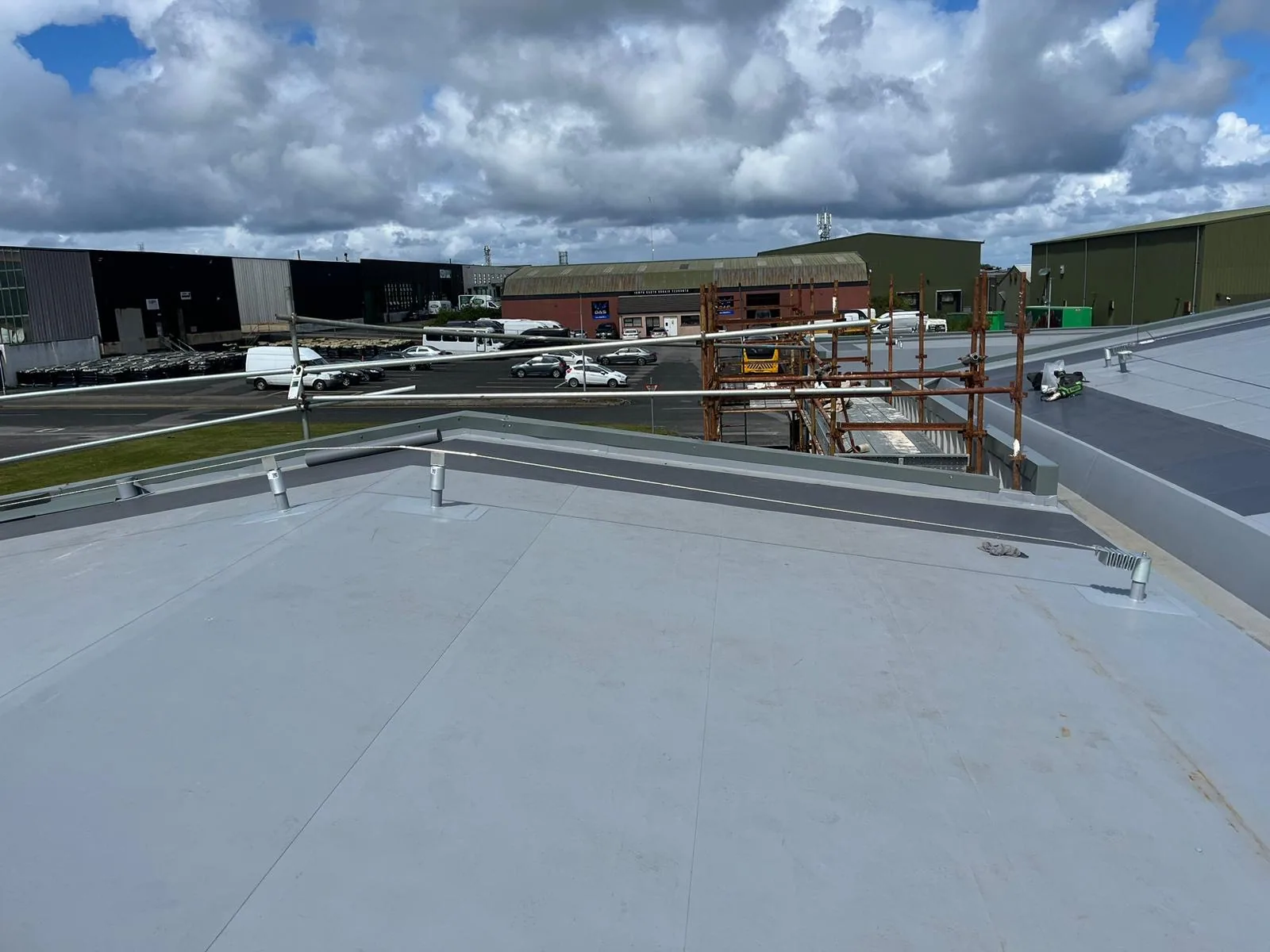
KEE Roofing in Denton, TX
A product label that says KEE does not settle the roof decision. The owner needs to know which membrane is installed, where it is confirmed, and what the current condition shows. In Denton, TX, record the roof area, inspection date, seams, flashings, repairs, and the basis of each product identification.
KEE is used in PVC-alloy membrane formulations. Product names and chemistry vary by manufacturer, so confirm the exact system from submittals, labels, or manufacturer records. Do not infer the assembly from color or appearance. A commercial roof inspection can document what is visible and where further confirmation is needed.
confirm the Product Record
Begin with closeout documents, shop drawings, warranty files, invoices, and any saved product packaging. Compare the listed membrane with field seams, thickness records, flashing details, and repair history. A document may cover a project phase rather than the whole roof. Mark the areas it supports and the areas that remain unknown.
KEE and PVC are not interchangeable labels for every purpose. A PVC sheet may use a particular formulation, reinforcement, or accessory package. Confirm product compatibility before writing a patch or replacement specification. If the roof contains more than one phase, map the transition and keep each system record separate.
For a side-by-side material discussion, use the PVC membrane review and TPO system page as comparison points.
Inspect Welds and Prepared Areas
Thermoplastic membrane seams rely on compatible preparation and welding. Inspect representative laps for separation, dirt, residue, wrinkles, or an earlier repair that bridges an irregular surface. Record the location and extent. Do not probe a seam unless the method is appropriate for that system and does not create damage.
If a repair is proposed, confirm that the existing sheet and accessories can accept the specified process. A clean test area can reveal preparation needs, but it does not by itself establish performance across every roof section. Document surface condition, ambient conditions, test outcome, and any manufacturer direction that applies.
A repair scope should say how the substrate will be prepared, how the tie-in will be made, and what will be inspected before closeout. Identify any condition that could not be confirmed during the visit.
Review Edges and Penetrations
The sheet field is only part of the assembly. Examine drains, scuppers, curbs, pipes, parapets, edge metal, expansion joints, and changes in roof height. Look for open corners, unsupported flashing, loose termination, or sealant where a specified membrane detail is expected. Relate close photographs to a roof map.
At equipment, record service paths, supports, lines, and any vibration or movement concern reported by the owner. Coordinate with the mechanical contractor before equipment is lifted or reset. A roof repair can be affected by work from another trade, and the scope should assign those responsibilities clearly.
Trace staining and interior reports to the roof area without treating one location as proof of entry. Water can travel in the assembly. If the boundary is unclear, document the limit of the inspection and consider targeted confirmation. A moisture survey may help choose test locations when roof construction and field conditions make the readings meaningful.
Separate Exposure and Water Questions
Where a building has kitchen exhaust, process discharge, or rooftop chemical storage, record the equipment, discharge direction, visible residue, and nearby membrane condition. Do not state that a particular formulation is suitable based on a generic product category. Confirm the exact product and exposure limits with the manufacturer and design team.
Local weather context can help with scheduling but cannot identify membrane performance at one property. NWS Denton normals for 1991 to 2020 provide regional temperature and precipitation context. They do not measure a roof surface, chemical exposure, or seam integrity. The inspection must address the actual assembly.
If a product question remains open, list it as an unresolved item in the scope version. Keep a proposed substitution separate from a repair recommendation so the owner can see which choice depends on product confirmation.
Record drains, overflows, scuppers, low areas, and points where water stands after a rain. Record debris, blocked strainers, loose components, and membrane conditions around the outlet. The report should distinguish a maintenance observation from a change to slope, drain height, or the roof assembly.
Denton County has a published tornado climatology covering reports over many decades. Regional event history is context only. It does not show that a specific roof experienced damage or establish a need for replacement. On an individual property, compare dated photographs, repair records, and current conditions.
When a leak is active, identify the interior area and any temporary protection. Keep the temporary measure distinct from permanent work. A later inspection can compare the same roof map and check whether the water path changed.
Compare the Work Against Capital Timing
A localized repair may fit when the defect has a defined limit, the surrounding membrane is serviceable, and product compatibility is established. Broader work deserves consideration when multiple seams or details fail, repeated patches accumulate, or concealed moisture changes the repair line. State which evidence supports each option.
Before comparing recover and replacement, review existing layers, insulation, deck, attachment, edge height, drainage, and the current permit path. The City of Denton identifies Downtown TIRZ as a defined area created to provide public infrastructure that supports redevelopment. That district designation does not establish any building roof age, ownership, or project schedule.
A replacement scope should state the tear-off boundary, phasing, temporary weather barrier, equipment coordination, transitions, and disposal allowance. Keep alternates comparable by roof area and exclusions. The owner can then weigh immediate repair against a future budget year without hiding uncertainty in a lump sum.
Plan for Access and confirmation
Before mobilization, agree on the site contact, occupied hours, staging area, roof restrictions, and decision date. Denton’s development plan discusses the Loop 288 and US 380 corridors as part of city access and growth. Use that only as general context; check current conditions and the property’s own entry rules for the visit.
Krum is an incorporated city near Denton, but a municipal name does not establish contractor availability or a travel time. Confirm the property address and authority that governs the roof work. Use the same project record whether the building is in Denton, Krum, or another service area.
If a coating or recover is proposed, confirm the KEE or PVC-alloy product, surface preparation, moisture condition, adhesion test, and manufacturer requirements first. A coating review should record eligibility checks and limits before that option is included in a bid.
Keep Product and Repair History Together
Closeout should let another reviewer understand the work without reconstructing the inspection. Keep the dated roof map, product identification, scope version, access records, prepared-area photographs, seam checks, repair limits, and exclusions together. Add the manufacturer response when it affects compatibility or warranty handling.
After completion, photograph the finished seam and each affected transition. Record what changed, what remained, and any condition that prevented the planned detail. Update the repair map so the next inspection can compare the same locations and distinguish a new condition from an earlier one.
For a Denton property, retain permit correspondence and the owner authorization with the same file. The current permit path should be confirmed for the actual commercial scope. A residential-permitting page does not determine the requirements for a commercial roof project.
Commercial Roofing Questions
How can an owner confirm that a membrane is KEE?
Match the field condition to submittals, labels, invoices, or manufacturer records. Map the portions confirmed and mark any area where the product remains uncertain.
Can a KEE or PVC-alloy seam be repaired with standard PVC materials?
Compatibility depends on the exact sheet, accessory, preparation, and repair method. Confirm the product requirements before pricing or applying a patch.
What should be checked before coating a KEE roof?
Confirm the existing product, moisture condition, surface preparation, adhesion testing, and coating-system requirements. Record the test area and any limits before proposing the work.
Does a roof leak below a seam prove the seam failed?
No. Water may travel through the assembly. Map the interior report, inspect nearby details, compare prior records, and identify what requires confirmation.
Which records belong in the KEE roof file?
Keep product identification, dated roof maps, inspection photos, repair scopes, compatibility guidance, closeout images, warranty correspondence, and unresolved items together.