
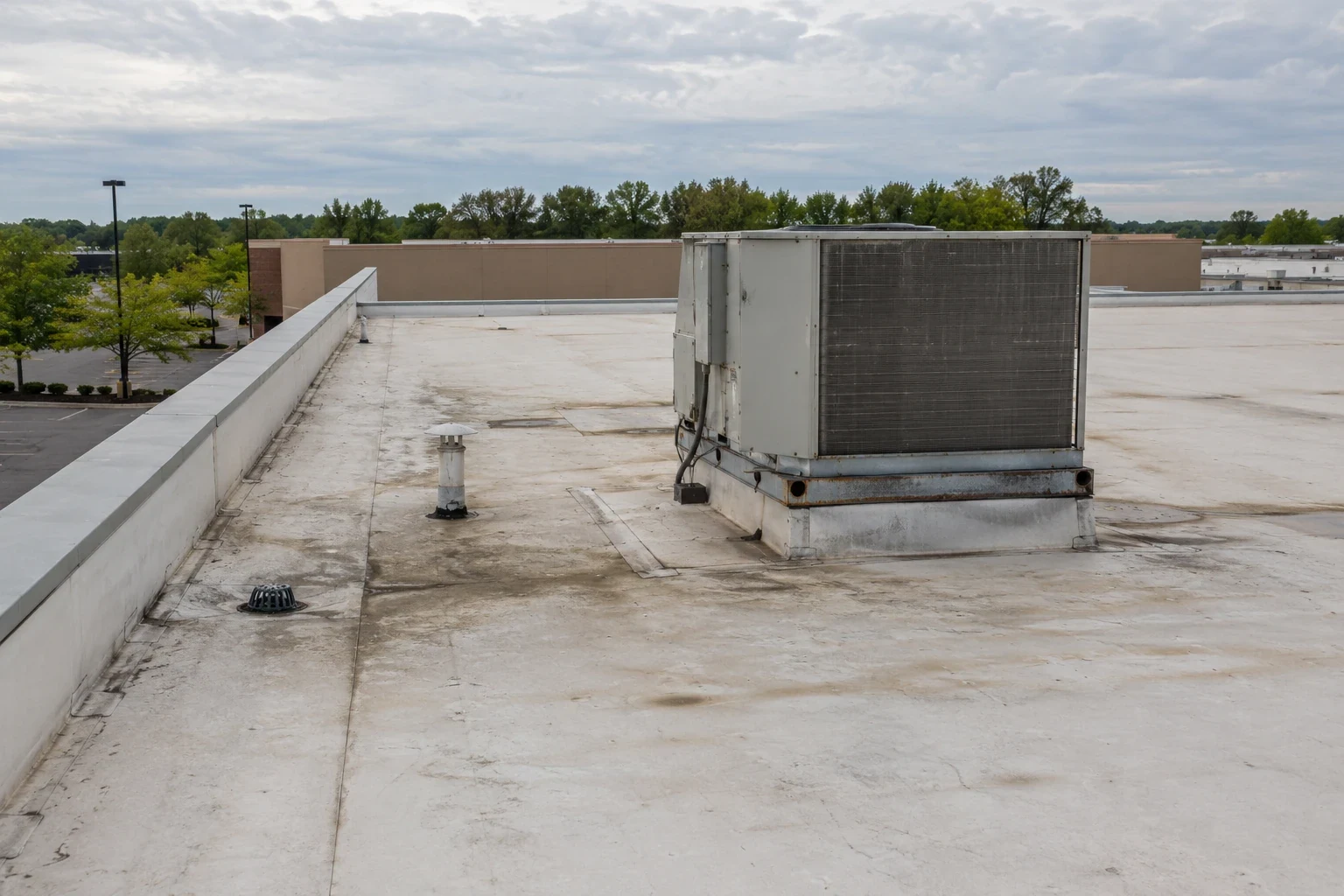
Big-Box Retail Roofing in Denton, TX
A leak above a sales floor is a location report, not a roof diagnosis. We record the time, affected bay, interior protection, and operating contact, then trace the issue against roof zones and accessible details. The owner gets a clear account of what was observed, what still needs testing, and which decision has a date attached.
Denton's July normal mean maximum is 95.9°F. Air temperature does not measure roof temperature or material condition. A large retail roof in Denton, Frisco, or Lewisville still needs an assembly-specific review of seams, insulation, drainage, attachment, and penetrations.
Divide the Roof into Work Areas
Use roof plans or owner identifiers to divide the area into inspectable zones. We record roof system, elevation changes, drains, scuppers, equipment curbs, skylights, and perimeter transitions within each boundary. A photo log ties each defect to a location the facilities team can find without relying on a broad label such as north roof.
If portions are inaccessible, we mark them as uninspected and state why. A condition report should not imply full coverage when access, weather, or safety rules limit the walk. That boundary helps a manager decide whether additional access or a different survey is needed.
Mark a large roof by work area before a crew begins. The facilities plan may use grid lines, roof letters, or equipment references; we preserve those identifiers and add photographs. This lets the owner locate a seam, drain, or perimeter detail without relying on a broad compass direction that can be ambiguous on a wide roof.
For a roof with frequent service traffic, identify walk paths and protection requirements before crews stage material. The owner may need to coordinate rooftop equipment access with maintenance staff. We include the staging area, delivery route, and protection responsibility in the work plan. If those conditions change, the manager can identify which roof zone and schedule assumption must be revised.
The estimate should also state whether the owner expects the roof to remain watertight each night during a phased replacement. We describe temporary tie-ins, exposed work boundaries, and the point where a new day's work begins. Those details affect both material handling and the operating plan. A schedule that leaves an unprotected edge is not a complete scope assumption.
Check Water Paths and Attachment
We inspect seams, flashing laps, fasteners, edge metal, drains, and penetrations for openings or movement. Interior reports are compared with those roof observations. If moisture may extend below the surface, we explain whether infrared review, test cuts, or other confirmation is appropriate and obtain approval before intrusive work.
Retail operations may depend on lighting, HVAC, refrigeration, and loading functions. Roof work around equipment needs a clear interface: identify the unit, curb, conduit, and responsible trade, then define who disconnects or protects it. We do not treat a roof repair as permission to alter equipment or building systems.
We inspect field seams and end laps for separation, patch edges for movement, and transitions where one material meets another. At perimeter metal, the review includes attachment, laps, corners, and terminations. A condition in one detail should not be applied to an entire roof until adjacent areas have been checked and the boundary is documented.
Set the Work Window Before Mobilizing
The owner sets store hours, delivery access, security rules, and any restricted periods. We use that information to plan staging, lift placement, noise, and interior protection. A repair in one zone may be isolated; replacement may require temporary tie-ins and a longer weather window. The proposal should state these assumptions so schedule changes have a traceable effect.
Denton's annual precipitation normal is 38.44 inches, a regional planning figure rather than a prediction for a workday. We confirm the near-term forecast before opening a roof area and keep temporary dry-in steps in the scope. The superintendent and owner contact need the same stop-work and closeout criteria.
Curbs, conduit, pipes, signs, and later equipment work can create roof penetrations. We record which trade owns each interface and whether the flashing appears integrated with the membrane. If a unit must be shut down or lifted, the owner approves the plan and assigns the appropriate trade. The roofing scope identifies its tie-in and excludes unrelated equipment work.
Price the Finding, Not the Building Label
A single failed penetration can support a repair when surrounding materials are sound. Broad seam distress, wet insulation, or deteriorated edges may change the scope. We show quantities by zone, identify exclusions, and separate optional work from the base recommendation. Cost and timing depend on access, assembly, moisture extent, material availability, and the amount of active protection required.
After work, the closeout record should show the repaired zone, photographs, materials identified, and any remaining limitations. Projects in Denton, Frisco, and Lewisville each begin with the actual roof record, access conditions, and owner decision date.
Where moisture is suspected, a moisture survey may guide targeted confirmation. A defined repair scope lists the repair line and limits; a replacement comparison should show quantities, tie-ins, staging, and dry-in assumptions.
Frisco and Lewisville are nearby municipalities in the service area; the roof plan, not the city label, defines the work area.
A receiving roof can share details with a warehouse roof assessment, while customer-facing areas may need coordination like a shopping center review. We can use a moisture survey to identify follow-up areas, prepare a repair scope, or compare a replacement scope. Near Lewisville, as in Frisco, the owner provides the current contact and operating rules.
A large roof needs a closeout map that can be handed to the next facilities shift. We tie each repair photograph to a roof grid or equipment reference and label any area that was not accessed. If temporary protection remains, the record gives its location and the follow-up date or condition that will trigger permanent work. For replacement, include tie-in points, perimeter details, drain modifications, staging assumptions, and weather protection in the base scope. Separate alternates for additional areas. That makes a bid comparison useful when operations, procurement, and the roof consultant review different parts of the project.
Denton's July temperatures and annual precipitation are regional context only. The observed assembly and the project's weather window govern the actual work plan.
Large roof areas can hide differences between the field membrane and the perimeter. We map the edge, corners, drains, and high-traffic routes separately, then connect each finding to photographs. A replacement estimate should identify any tear-off, substrate review, insulation replacement, or recover option being priced. If access is restricted to a portion of the roof, the unreviewed boundary stays explicit. That gives procurement a clear base for comparing bids and lets operations see whether a future visit, equipment shutdown, or added protection is still required.
Commercial Roofing Questions
What records help before a large retail roof inspection?
Send the roof plan, prior reports, repair history, leak locations, equipment list, and the facilities contact. The inspection plan will identify accessible zones and any testing that needs a separate approval.
Can a roof be repaired without closing the store?
Often the work can be planned around owner-set operating conditions, but access, noise, staging, weather, and interior protection determine the sequence. We list those assumptions before mobilization.
What if the leak is far from the roof opening?
We compare the reported interior location with seams, transitions, drains, and penetrations. The report distinguishes a suspected route from a confirmed entry point and identifies the next confirmation step.
How do you handle rooftop equipment?
We identify equipment and curbs that affect the roof scope, then coordinate responsibilities with the owner and appropriate trade. A roofer should not assume authority to disconnect or change building systems.