
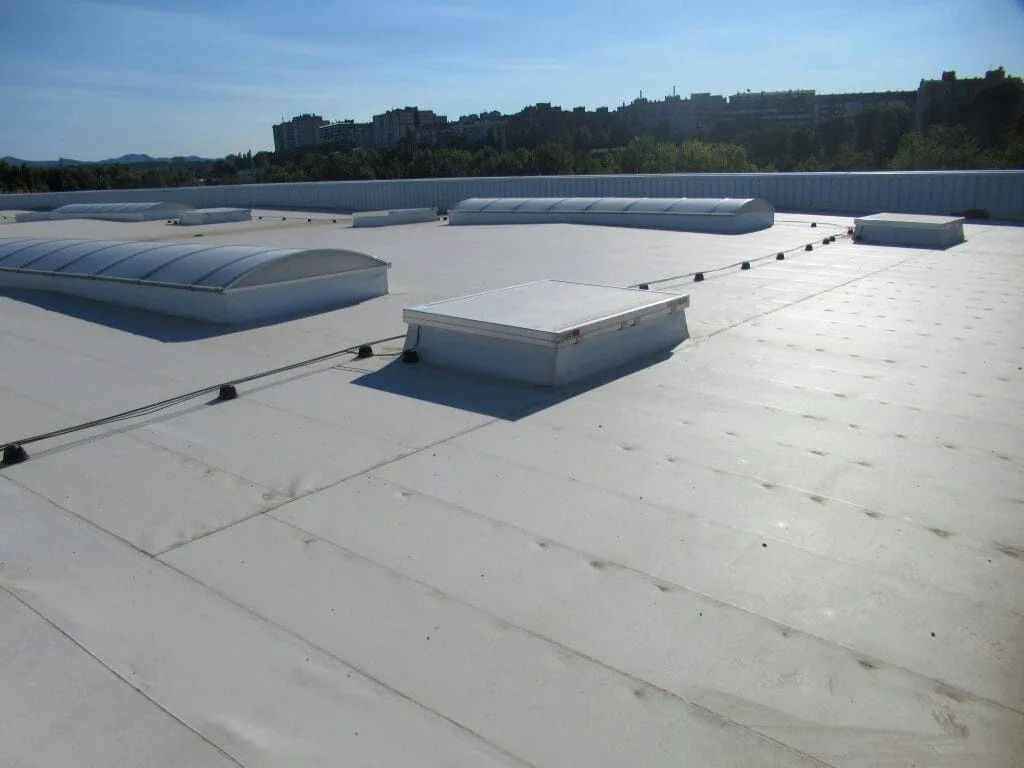
Holcim Elevate Commercial Roofing in Denton, TX
An older closeout file may say Firestone Building Products while a current project refers to Holcim Elevate. That name change should not blur the assembly record. For a Denton, TX commercial roof, we identify the installed membrane and accessories by roof area, compare the file with field conditions, and set the next decision from what can be confirmed.
Holcim Elevate commercial products include low-slope membrane assemblies. Older records may use the former Firestone Building Products name. A commercial roof inspection documents seams, flashings, drainage, attachment, and prior repairs. We keep product identity separate from the observed condition and from any warranty question.
Reconcile Current and Older Documents
Gather original submittals, shop drawings, invoices, closeout photographs, repair work orders, and warranty correspondence. Record the company name and document date, then map the record to its roof area. A historic manufacturer label does not by itself show which product remains installed after later repairs, overlays, or partial replacement.
Compare the paperwork with membrane labels, seam style, flashing materials, cover board, insulation, and attachment. If records name a product such as UltraPly TPO or RubberGard EPDM, confirm that the named material matches the specific area being reviewed. Keep changes and field substitutions visible. A Carlisle SynTec project file or GAF system record may be part of a separate roof phase, so do not fold it into the Holcim Elevate history without evidence.
Where an owner has only a warranty summary, list what it does and does not identify. Record the next needed item, such as an archived submittal, label, installation detail, or manufacturer response. That keeps the bid comparison from assuming more than the file establishes.
Inspect the Installed Details
On a thermoplastic sheet, examine representative welds for separation, contamination, wrinkles, open corners, and prior repairs. On an EPDM area, review tape or adhesive seams, surface preparation, and lap edges. At each location, photograph the roof context and the close condition. Do not choose a patch method until the membrane and accessory compatibility are established.
Trace the field sheet to curbs, pipes, drains, parapets, edge metal, and changes in roof height. Check termination, flashing support, movement, and service-path damage. Water staining inside a room can point to an area to investigate, but the roof route may be elsewhere. Map the interior report and roof observations separately. A repair assessment can define the test or access needed before the permanent repair line is set.
Westpark TIRZ is an industrial district north of Airport Road. For an occupied property near that district, an access record and delivery plan can affect inspection timing. The district reference does not identify the property assembly or its roof condition. Those remain field questions.
Compare the Next Work Scope
A bounded puncture or seam defect may support a local repair if adjacent sheet is serviceable and compatible materials are available. State the preparation, area, tie-in, and confirmation method. Put temporary water protection on a separate line when it is needed before the permanent work window. The owner can then see what addresses immediate exposure and what completes the correction.
Several recurring seam failures, wet insulation, deteriorated flashing, or unresolved attachment can justify a larger review. Map each finding and identify the evidence that would change the recommendation. A roof age alone is not a replacement scope. Compare repair, recover, and tear-off only after reviewing existing layers, deck condition, drainage, edge height, insulation, and rooftop equipment.
A replacement scope should show work boundaries, temporary dry-in, phasing, disposal, and transitions. A coating review should first confirm system eligibility, moisture condition, surface preparation, adhesion testing, and applicable product requirements. Keep each option tied to the Holcim Elevate system actually documented at the property.
Set a Weather and Access Plan
The normal record for Denton puts its July mean high at 95.9 degrees Fahrenheit and yearly rainfall at 38.44 inches. Those figures set regional context only. A surface reading, current forecast, and product installation conditions govern the work window at one property.
Loop 288 and US 380 are transportation corridors discussed in city planning materials. Check current routes, construction, gate instructions, and delivery restrictions before mobilizing. Confirm occupied hours, roof access, fall protection, staging, and equipment paths with the property contact. The work plan should name who can pause the job and how the roof is secured if weather interrupts a shift.
For a roof near Lake Dallas or Hickory Creek, confirm the actual address and governing jurisdiction. The place name does not settle permit requirements or arrival time. Put site-specific access and permit checks in the work order rather than assuming they follow from the market name.
Keep Warranty and Scope Questions Apart
A product record and a warranty file answer different questions. The roof inspection describes observed conditions. Warranty correspondence may identify notice steps, covered components, exclusions, or maintenance obligations. We keep both in the project file and flag questions that need the manufacturer's review. We do not treat a warranty document as proof that all current defects are covered.
Compare bids using the same roof areas, membrane details, substrate assumptions, flashing, edge metal, drainage, equipment coordination, temporary protection, exclusions, and closeout requirements. If a proposal relies on an opening or moisture test, show the location, method, and cost assumption. Preserve inspection dates and photographs in the project file without treating a storm report as proof of cause.
When work may be staged, a capital plan should connect each budget year to a mapped condition and decision date. Keep the base scope and alternates separate. Record what new evidence would change the selected path.
Maintain a Traceable Roof File
Closeout includes the approved assembly, product data, scope version, marked roof plan, photographs, repair boundaries, access records, and field changes. Show the finished detail and any limitation that prevented the planned work. Where legacy Firestone documents and current Holcim Elevate records both apply, file them by roof area and date so a later reviewer can follow the sequence.
For future inspections, use the same area identifiers. Compare new images with the earlier record, mark completed corrections, and keep unresolved items distinct from new findings. Retain correspondence that changes product compatibility or warranty handling. The file should support the next repair or capital decision without making the owner reconstruct the history from unrelated attachments.
Send the roof area, decision date, available Holcim Elevate or legacy Firestone records, and access contact. We will document the observed conditions and outline a scoped next step for the Denton property.
Commercial Roofing Questions
Do older Firestone Building Products records still matter for an Holcim Elevate roof?
Yes. Keep the original submittals, warranty file, and repair history. We map each document to the roof area and date, then compare it with the current assembly rather than assuming the whole roof stayed unchanged.
How do we confirm whether the roof is TPO or EPDM?
Use product records and field details together. We compare labels, seams, flashing, and accessories, then record which areas are confirmed and which need a manufacturer or design-team review.
Can an Holcim Elevate membrane be coated or recovered?
Eligibility depends on the existing assembly, moisture condition, preparation, testing, and the selected product requirements. We record those checks before presenting coating or recover as an option.
Should a warranty claim decide the repair scope?
The warranty file may affect notice and documentation steps, but the field condition still needs its own inspection record. We keep the observed defect, coverage question, and proposed correction separate.
What should a replacement comparison include?
Use matching roof areas and state tear-off, substrate, insulation, flashing, edge, equipment, temporary protection, phasing, and exclusions. Map open questions that could alter the base scope.